
For anyone dreaming of leaving the corporate 9-to-5 behind, one question inevitably rises above all others: 💭 is it safer to buy a franchise or to build a business from the ground up? In this episode we try to tackle this age-old dilemma head-on. Our hosts unique credibility stems from having walked every possible path: holding a traditional job, launching a business from scratch, buying and selling existing businesses, and owning a franchise. That breadth of experience allows them to compare these routes not on theory, but on lived reality. 🎙️
🛡️ Redefining "Safer"
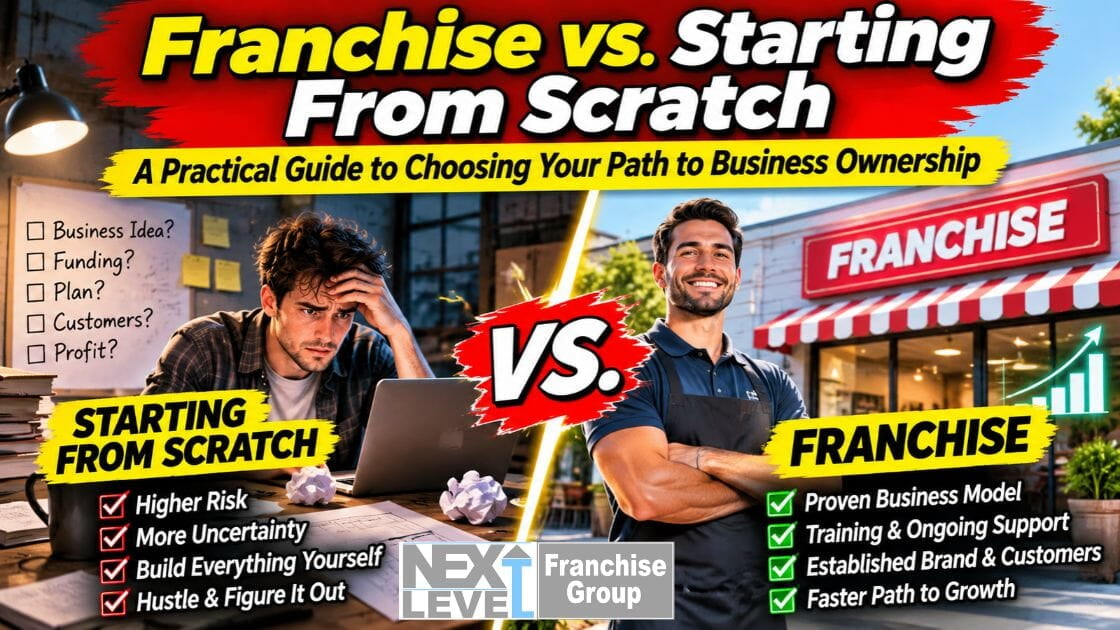
The conversation begins by unpacking what "safer" actually means. When you buy into a franchise, you are fundamentally minimizing your business risk. You inherit a proven model complete with established systems, marketing frameworks, training programs, brand recognition, and vendor relationships. Perhaps most valuable of all, you gain the distilled experience of everyone who came before you — people who already made the costly mistakes so that you don't have to repeat them. 💎
The hosts frame the decision elegantly: when you start from scratch, you must invent the recipe yourself. When you buy a franchise, you are handed a recipe that has already been tested in the real world. For a first-time business owner with no prior experience, following a validated recipe is often a far more sensible choice than attempting to create one from nothing.
📊 The Statistics That Change the Calculus
Numbers cut through emotion. Dave cites a striking contrast: only about one in ten independent startups survive beyond five years, while roughly 86% of franchises are still operating after the same period. This effectively flips the odds of success. However, the hosts are careful to add nuance. If you do choose to start from scratch, you dramatically improve your chances by operating in an industry where you already hold genuine expertise or a unique personal advantage. To illustrate, they joke that a chip designer probably shouldn't open a dog spa 🐶 — the fit between founder and industry matters enormously.
⚠️ Why Franchises Still Fail
A crucial lesson from the episode is that proven does not mean guaranteed. Franchises are not a 100% safety net. They fail for real and identifiable reasons:
Wrong market 📍 — the concept simply doesn't resonate in a given location.
Undercapitalization 💸 — many businesses run out of money before they run out of customers.
Poor management 🧑💼 — the wrong person placed in the wrong role.
Unrealistic expectations 🎯 — assuming profits will pour in within months.
Bad fit 🔀 — being matched with a franchise that doesn't suit your lifestyle, budget, or goals.
This is precisely why working with a knowledgeable advisor who can help narrow down the options is so valuable.
💰 Understanding Fees and Royalties
One of the most common objections to franchising is the resentment toward franchise fees and ongoing royalties. The hosts offer a compelling counterpoint: if you build a business independently, you still pay for those functions — customer service, accounting, marketing — you simply have to source and manage them yourself. A well-run franchise leverages economies of scale 📈, performing these services on behalf of hundreds of units, which means you benefit from a professional team you could never afford to hire individually.
🏦 The Capital Advantage
Undercapitalization is one of the leading causes of business failure, and here franchising offers a structural advantage. Because a franchise represents a proven system, lending institutions — banks, private equity firms, and others — are far more willing to extend borrowed capital. Compare that to an independent startup like "Susie's coffee shop," where the founder has minimal industry experience; lenders are understandably hesitant. This access to funding is a benefit that the hosts argue outweighs the cost of fees entirely.
☕ A Real-World Illustration
Dave and Stacey share their own franchise experience in the coffee-and-smoothie space. Despite knowing nothing about coffee or smoothies, the brand's established vendor and partner relationships helped them dominate the DC market. Name recognition opened doors — venues already understood the concept, making relationship-building nearly effortless. The result: they scaled to targets in a single year that would take most independent operators five years to reach. 🚀
🔓 The Freedom Paradox
Addressing the fear of losing control, Stacey argues that franchisees actually gain freedom because the underlying systems and playbooks support them. Yet this comes with a candid caveat: franchising is not for rebels. If you're the type who wants to reinvent everything and do it "your own damn way," you will likely struggle following a playbook. The rules, however, are usually negotiable and reasonable, and the collective intelligence of hundreds of other franchisees works toward a shared goal.
📄 The FDD: Your Due Diligence Tool
The good news for prospective buyers is the Franchise Disclosure Document (FDD) — a legally required document that enables real validation. Two sections deserve special attention:
Item 7 📝: lays out, line by line, the costs of entering the business.
Item 19 📈: reveals actual revenue data from existing franchisees.
This is transparent, real-world information. By contrast, when starting from scratch or buying an existing business, you rarely receive anything close to this level of disclosure — you typically get only what the seller chooses to share.
🧭 Who Should Choose Which Path?
The episode concludes with a practical decision framework. Starting from scratch suits the highly entrepreneurial, risk-taking innovator — the "Elon Musk" type who craves control, dislikes taking orders, and can pivot quickly when things fail. Franchising suits someone who has never owned a business, is comfortable following a proven recipe, and is willing to pay ongoing fees for support — particularly someone leaving a job who needs reliable income replacement. For that person, the hosts believe there is no better entry point into business ownership. ✅
🎯 The franchise-versus-scratch debate has no universal answer — it depends on your temperament, experience, resources, and risk tolerance. What the episode makes clear is that franchising meaningfully reduces risk for first-time owners by providing a proven model, access to capital, and the accumulated wisdom of an entire network. Starting from scratch rewards the fearless innovator but demands tolerance for failure and versatility across every business function. Whichever path you choose, the key is honest self-assessment and rigorous due diligence.
What's Your Next? - Podcast
 | Author BioI’m Stacey Riska aka “Small Business Stacey”, your franchise placement specialist. I help aspiring business owners find the PERFECT franchise so they can get to the next level in life and business. |