
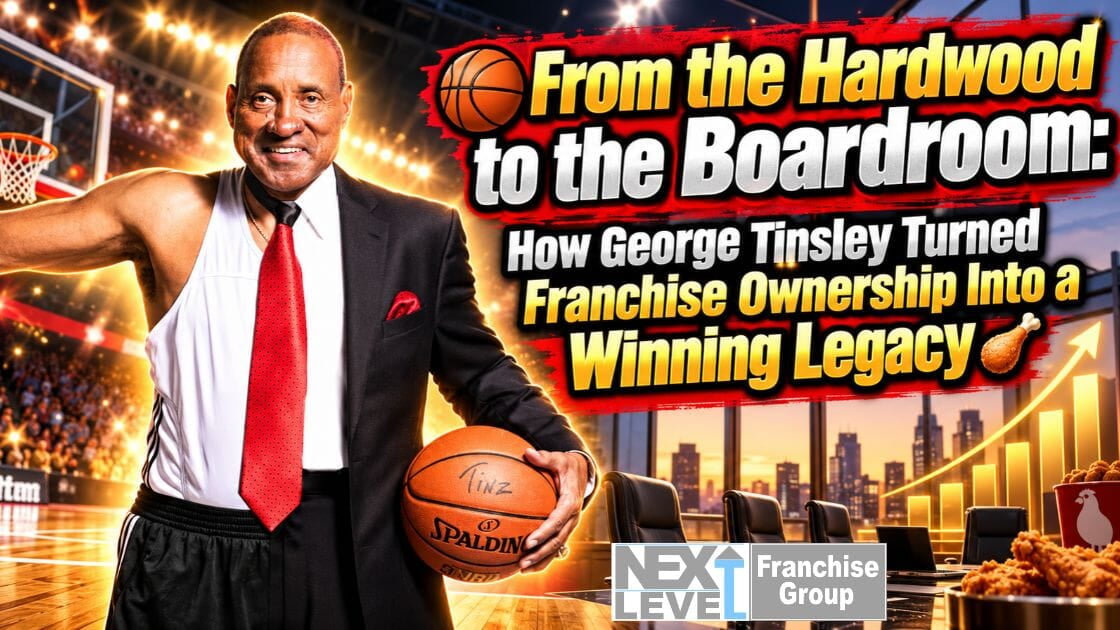
Few careers follow a straight line, and fewer still weave together as many disparate threads as that of George Tinsley. 🎙️ In this episode of What's Your Next, our host sits down with a man whose life reads like a serialized adventure — NCAA national champion, professional basketball player, international goodwill ambassador, teacher, coach, KFC executive, franchisee, and author. What emerges is not simply a success story, but a masterclass in how one chapter of life can be deliberately used to build the next. 💡
The Foundation: Discipline Built on the Court 🏆
The first lesson Tinsley teaches is that early failure is not destiny, but data. He entered college aiming simply to become a teacher and coach, yet nearly flunked out in his freshman year, landing on academic probation because he had never learned how to study. His priorities were misplaced, and the prevailing reputation among athletes at his school was that they did not graduate.
What changed everything was exposure and accountability. Winning a championship in his freshman year and traveling across the country, Europe, and Africa as a goodwill ambassador gave him perspective — and the scare of academic probation gave him discipline. He got himself off probation, earned All-American honors, and helped win three national championships. The educational takeaway is clear: the habits that save you are often forged in the moment you realize you are failing. Resilience is not a personality trait; it is a practiced response. 💪
Plan B Is Not Defeat — It Is Insurance 🛡️
Tinsley was drafted by both the NBA and the ABA, and as a poor young man he chose the ABA because it offered money up front. Yet his most strategic decision was not which league to enter, but what he kept in reserve. Watching teammates get cut and bounce from team to team convinced him that his college education was invaluable as a fallback. He became the first African-American athlete to graduate from his college, alongside his teammate, and when his playing career ended, he returned to his original dream of teaching and coaching, winning state championships in track and basketball.
The lesson for entrepreneurs is that your fallback plan is not an admission of doubt — it is a stabilizer that lets you take bigger risks. 🎯
Access and Apprenticeship: The Value of Being in the Room 🚪
When teacher's salaries proved insufficient to support a growing family, Tinsley considered the FBI before accepting a better-paying training role at Kentucky Fried Chicken. There he found himself working directly with Colonel Sanders himself, immortalized in a photograph of the two of them under the tagline "Tinsley still making buckets." 📸 Although the Colonel was present for only three days per class, the experience was formative.
Crucially, Tinsley understood that he lacked a business background, so he invested roughly six months working inside restaurants to learn management, kitchen operations, and financial management. He then worked eight years in training, moved into operations running restaurants in Atlanta, became a human resources director, and served as a franchise manager. Only after eight years of understanding the industry from the inside did he pursue ownership. 🔑
The educational principle here is apprenticeship before ownership. Deep familiarity with a system's operations, economics, and culture dramatically reduces the risk of failure once you are responsible for the outcome.
Winning by Following the System 📋
Tinsley's most quoted lesson is that success came not from reinventing the wheel but from respecting it. He bought into the brand's philosophy and refused to deviate from its policies and procedures, even when doing well. He paid his royalties and marketing fees, conducted local marketing, and held himself accountable to the franchise relationship.
This discipline produced remarkable results. His KFC in Auburndale, Florida, was the number one KFC in the nation for forty years. His Tampa airport TGI Fridays, budgeted for $1.5–2 million, opened at $3 million in its first year and became the number one TGI Fridays in the nation for nine consecutive years. 🥇
The lesson: in franchising, the system is the competitive advantage. Franchisees who honor the brand's standards and invest in execution frequently outperform those who try to short-circuit the model.
Turning Obstacles into Opportunities 🔥
Perhaps the most instructive narrative in Tinsley's story is the fire that destroyed his number one KFC after five years. Rather than despair, he stood in the parking lot, watched the delivery trucks leaving, and followed them to their destinations. He bought his own truck, converted it into "KFC on wheels," and beat the competition to those spots by selling from his remaining stores. Meanwhile, he used the rebuild to correct the store's weaknesses in throughput, parking, drive-thru flow, and service systems. When it reopened, annual volume doubled from $1 million to $2 million. 📈
The educational takeaway is a practical one: crisis reveals weak points you were too comfortable to fix. Adversity is a diagnostic tool, and often the most ambitious version of your business emerges only after a setback forces reinvention.
People, Community, and Reputation 🤝
Tinsley repeatedly returns to two pillars: customers and employees. He credits his success to treating customers as number one while genuinely caring for employees, and to ongoing coaching rather than abdication — "you can't just walk away." The Tampa TGI Fridays became a community gathering place, where travelers could park free for an hour, enjoy a burger and a cold beer, and spread the word. 🍔🍺 This is a reminder that reputation is built through consistent, generous participation in a community, not through advertising alone.
Practical Advice for First-Time Entrepreneurs ✅
For those considering the leap, Tinsley offers a structured checklist:
Believe and commit. Genuine commitment is the precondition for success. 💥
Match the business to your profile. If a concept does not fit who you are, it will not work long term.
Choose a franchise with real support. Look for robust training, site selection assistance, and resources that match your specific needs.
Respect the site selection process. Branded concepts will dictate candidate locations; you cannot simply pick your own.
Be adequately capitalized. Most restaurants fail within the first three years, largely due to under-capitalization. ⚠️
Get professional support. Legal and accounting guidance is essential.
Read the franchise disclosure document. Understand the history and track record of the system before signing.
Evaluate regularly and know when to walk away.
Legacy and the Meaning of "Next" 🌱
Finally, Tinsley's story closes on the theme of legacy. He has transitioned the company presidency to his son and now operates in a support role. He credits his wife, Sertha Tinsley, met in college, as central to his success and his renewed focus on education, and he honors the memory of his late daughter. His book, Catch as Catch Can, along with his earlier work The Determined Entrepreneur, preserves these lessons for future readers. 📚
The overarching educational message is that success is not a destination but a relay: education becomes discipline, discipline becomes apprenticeship, apprenticeship becomes ownership, ownership becomes community, and community becomes legacy. Each chapter prepares the next — provided you are willing to learn from it. 🏁
What's Your Next? - Podcast
 | Author BioI’m Stacey Riska aka “Small Business Stacey”, your franchise placement specialist. I help aspiring business owners find the PERFECT franchise so they can get to the next level in life and business. |