
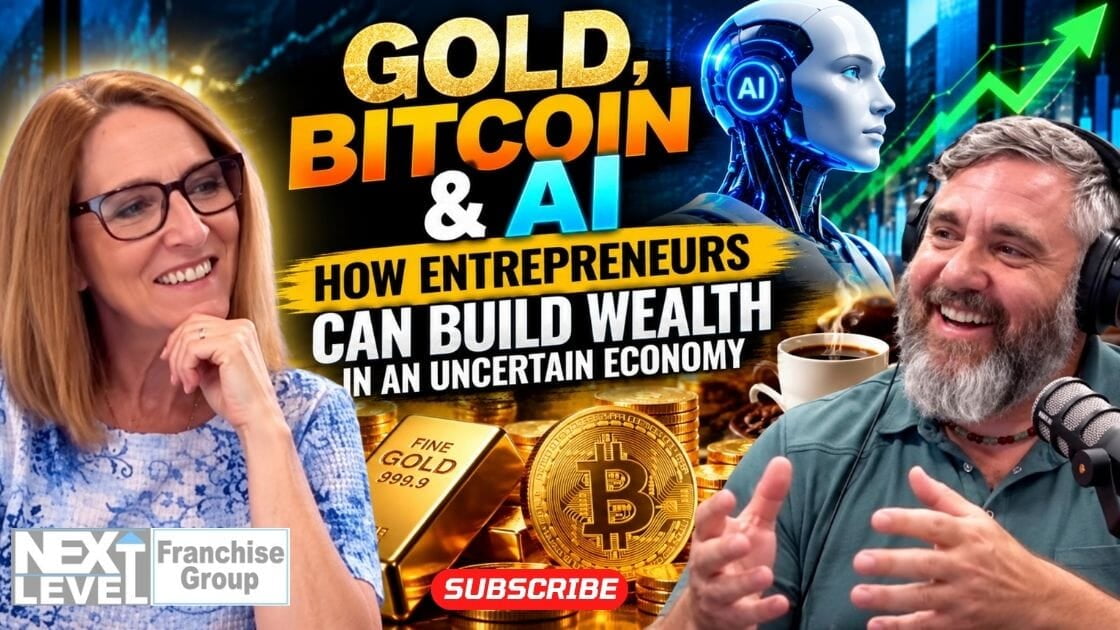
Economic uncertainty can make entrepreneurs feel as though they need to predict what will happen next. But the central message of Tony Arterburn’s conversation is different: business owners don’t necessarily need better predictions—they need a stronger understanding of money, purchasing power, risk, and adaptability.
From financial literacy and inflation to gold, Bitcoin, AI, and entrepreneurship, the conversation explores how business owners can become more resilient in a rapidly changing economy.
💵 Money Is More Than the Number in Your Account
One of the episode’s biggest themes is the distinction between the amount of money you possess and what that money can actually buy.
Inflation matters because rising prices reduce purchasing power. A business can increase its nominal revenue while simultaneously facing higher costs for labor, energy, materials, insurance, financing, and other expenses.
Tony connects this problem to the modern fiat monetary system. He points to the United States’ departure from dollar convertibility into gold in 1971 as an important historical turning point and argues that expansion of the money supply contributes to the long-term erosion of the dollar’s purchasing power.
For entrepreneurs, the practical lesson is simple: think about inflation and purchasing power, not merely the number of dollars coming into the business.
🎓 Financial Literacy Should Be Practical
Tony argues that financial education should begin with ordinary life.
Young people can learn about money by seeing what housing, electricity, gasoline, insurance, food, taxes, and transportation actually cost. Entrepreneurs can apply the same principle to their businesses.
A business owner doesn’t need to become a monetary economist. But understanding concepts such as inflation, interest rates, credit, debt, liquidity, and purchasing power can improve decisions about pricing, borrowing, expansion, and saving.
This turns financial literacy from an academic subject into a practical decision-making tool.
🪙 Gold, Silver, Bitcoin, and the Power of Scarcity
A substantial part of the conversation focuses on assets Tony considers scarce.
He views physical gold and silver primarily as long-term stores of value rather than short-term speculative investments. Their attraction, in his framework, comes partly from the difficulty of creating additional supply compared with fiat currency.
Bitcoin enters the discussion for a similar reason. Its protocol establishes a maximum supply of 21 million bitcoins, which Tony considers an important form of digital scarcity.
He expects Bitcoin investing and ownership to become increasingly relevant to businesses and sees parallels between Bitcoin and precious metals.
However, these ideas should be distinguished from guaranteed investment outcomes. Scarcity alone does not guarantee that an asset will maintain or increase its market value, and cryptocurrencies and precious metals carry their own risks.
🏆 What Collectibles Can Teach Us About Investing
The conversation broadens from traditional assets to sports cards, Pokémon cards, rare coins, Hot Wheels, artwork, and other collectibles.
These examples introduce an important financial concept: liquidity.
An item might theoretically be worth thousands of dollars, but realizing that value requires finding someone willing to buy it at that price. A rare collectible can therefore appreciate dramatically while remaining considerably harder to sell than an asset traded in a large global market.
When considering an asset, entrepreneurs can ask four useful questions:
How scarce is it?
Can additional supply easily be created?
How strong is demand?
How easily can I convert it into cash?
That framework applies far beyond collectibles.
📊 Preparing Your Business for Economic Stress
Perhaps the most immediately applicable part of the conversation concerns business resilience.
Tony encourages entrepreneurs to understand their industries deeply and model adverse scenarios before those scenarios actually happen.
What happens if sales decline? What if financing becomes more expensive? What if inventory is delayed? What if suppliers suddenly change their payment terms?
Liquidity becomes particularly important in these situations.
Credit can also provide flexibility, although Tony cautions against excessive leverage. The objective isn't simply to borrow more money. It's to ensure that a company has options when conditions change.
This is also where AI for entrepreneurs can become particularly useful. Business owners can use AI tools to model different revenue assumptions, financing costs, inventory delays, supply-chain problems, and cash-flow scenarios—potentially identifying vulnerabilities before they become emergencies.
🤖 AI Could Make Human Relationships More Valuable
Interestingly, the discussion about artificial intelligence doesn't conclude that humans are disappearing from business.
Instead, Tony emphasizes qualities technology has difficulty reproducing completely: authentic relationships, trust, expertise, responsiveness, and personal service.
Stacey describes this concept as H-to-H: human to human.
For small businesses, that can become a competitive advantage. AI may automate administrative work, analysis, communication, and other repetitive tasks, allowing entrepreneurs to devote more attention to the parts of the customer relationship where human judgment and connection matter most.
🚀 Entrepreneurship Is Continuous Adaptation
Tony's own career illustrates another theme of the episode.
After military service and involvement in multiple businesses—including precious metals—he continues looking for new opportunities. His next project involves coffee, a product he personally enjoys and also views through the lens of commodities and entrepreneurship.
That example captures the broader philosophy of the conversation.
Financial resilience doesn't come from correctly predicting every recession, market movement, technological disruption, or monetary-policy decision.
It comes from understanding the economic forces affecting your business, maintaining flexibility, controlling risk, protecting liquidity, and continuing to adapt.
For entrepreneurs, the most useful question may therefore be the one at the heart of the show:
What is your next? 🚀
What's Your Next? - Podcast
 | Author BioI’m Stacey Riska aka “Small Business Stacey”, your franchise placement specialist. I help aspiring business owners find the PERFECT franchise so they can get to the next level in life and business. |