
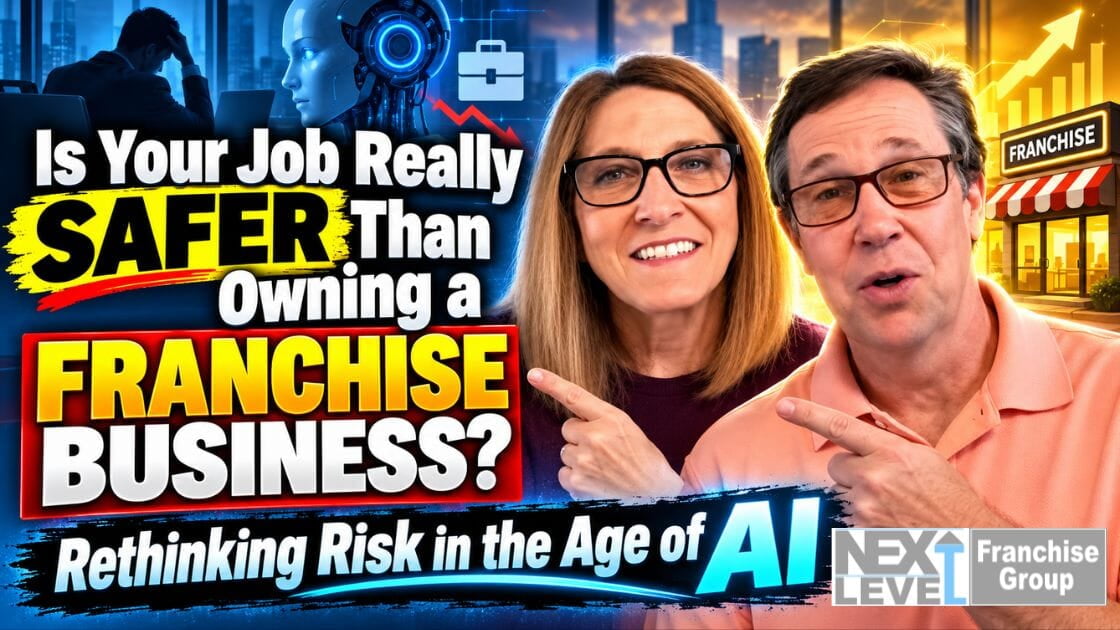
In a rapidly shifting economic landscape, one question has moved from the margins of business conversation to its very center: Is your job really safer than owning a business today? In this episode of What's Your Next, our hosts — a husband-and-wife franchising duo — tackle this question head-on, dismantling the comfortable assumptions many workers hold about the security of employment. ⚡ Their discussion is not a sales pitch for entrepreneurship, but a careful examination of risk, control, and timing that every professional should consider.
⚖️ Reframing the Debate: Everything Comes Down to Risk
Stacey opens the conversation by grounding it in a single concept: risk. Rather than treating jobs and businesses as opposite categories of safety, she argues that both carry risk — the question is simply where that risk lies and how visible it is. 🔍
Up until roughly a year ago, she would have said that owning a business was the riskier path. The reasoning is intuitive: a business owner has money invested, employees to pay, customers to satisfy, and expenses to cover. Debt is often involved, and external pressures such as tariffs can squeeze margins without warning. By contrast, a job feels safe because you show up, do your work, and every week or two money appears in your bank account with predictable reliability. 💵
But predictability is not the same as safety — and that distinction is the intellectual heart of the entire episode. 🎯
🤖 The AI Disruption: A Job Crusher in Plain Sight
In the span of just five months, AI has replaced 112,000 jobs — and that figure only counts the displacements that are known and documented. The real number, the hosts suggest, is likely higher. 📈
More alarming still is the projection, cited from a Gallup poll, that certain industries will be disproportionately affected. In accounting and insurance, for example, roughly one in three jobs could be replaced by AI. We use AI constantly and consider it a valuable tool. But admiration for a technology does not negate its disruptive power. As our host bluntly puts it, AI is coming, and it is going to be a "job crusher." ☠️
This framing matters because it dissolves a common illusion: that automation only threatens manual or low-skill labor. The data points squarely at white-collar, credentialed professions — the very careers many people pursue precisely because they believe they are secure. 🧠
⏳ The Hidden Risk of Employment: Time to Recover
The hosts then introduce a dimension of risk that is almost never discussed: recovery time. Even if you keep your job today, what happens if you lose it tomorrow? Based on what they are hearing, finding comparable employment could take months — if not years. 🕰️
This reframes the safety calculation entirely. A steady paycheck is only safe if it is durable. If the underlying position can vanish and its replacement is slow to materialize, then the "stable" income stream is actually a concentrated, unrecoverable bet. The risk didn't disappear; it was simply deferred and hidden. 🔥
🔢 One Is the Loneliest Number
Perhaps the most memorable idea in the episode is Stacy's analogy between employment and customer concentration. Imagine owning a business where a single customer provides 100% of your income. Would anyone call that safe? Absolutely not — it is the textbook definition of business fragility. 💔
And yet, that is precisely the structure of a traditional job. You have one employer, one income source, one point of failure. No matter how much that job pays — the hosts mention people earning $150,000, $200,000, even $300,000 annually — if a single organization controls that money, your security is contingent on decisions you do not make. 😰
Those decisions arrive constantly: reorganizations, new CEOs, outsourcing, changing rules, and the ubiquitous "organizational shakeup." Behind any of them, a six-figure income can evaporate overnight. The lesson Stacy draws is pointed: if you are going to rely on one source, let that one be you — make the decisions, and build the team around yourself. 💪
🚫 Neither Panic Nor Fantasy: Avoiding Two Traps
The hosts are equally careful to reject two opposite errors.
The first is the dream of effortless wealth. Social media, they warn, propagates the fantasy that you can lounge by the pool while money "miraculously" flows into your account and employees run everything for you. That, in their words, is nonsense — and they credit their audience with enough sense to see through it. 🙄
The second is panic. When people sense pink slips coming, the instinct is to rush into a business out of fear, or to quit dramatically. Both are emotional decisions, and emotional decisions made under pressure rarely end well. Desperation, they insist, is the worst possible foundation for an entrepreneurial leap. 😤
📚 The Constructive Path: Learn Before You Need To
So what should someone concerned about their future actually do? The answer is deceptively simple: keep your options open, and start learning now. 🌱
Learning about business ownership and franchising costs nothing. It is exploration, not commitment. You may discover that franchising is not right for you — and that is a perfectly valid outcome. The value lies in making the assessment calmly and early, rather than blindly and desperately after severance runs out.
The hosts also emphasize that this is not an all-or-nothing choice. Many people who cannot afford to surrender full-time income can pursue a second stream of income — part-time, semi-absentee, or supplemental. Multiple income streams, they stress, are always safer than one. Diversification is risk reduction, and it applies to income just as much as it applies to investment portfolios. 💰
🎯 Who Should Consider Business Ownership?
The hosts draw a clear profile. You should not consider business ownership if you are:
😱 Desperately seeking a magic solution after a layoff
🚨 Operating in panic mode, making emotional choices
🛋️ Expecting a semi-absentee lifestyle where the business runs itself
Conversely, you are well positioned to explore if you are thinking ahead — investigating what is involved, asking whether franchising fits, and clarifying whether you want part-time or full-time involvement, full income replacement or augmentation. Ideally, you begin this exploration before you feel any urgency, so that your judgment is clear rather than clouded by fear. 🧭
🕹️ A Closing Case for Control
AI and robotics are arriving, and large corporations are investing not just billions but trillions of dollars to deploy this technology and streamline operations across every kind of organization. Some businesses will be augmented; others will be destroyed. The transition will be chaotic. 🌪️
In that environment, the one thing you can do is take control of your own situation. Owning a business does not guarantee success — the hosts are honest about that. But it does place you in the driver's seat, giving you freedom and flexibility that employment cannot offer. The prudent move is not to wait for a crisis, but to consider the options now, while you still have the clarity and the leverage to choose well. 🏆
The episode's core message is not that everyone should quit their job, nor that business ownership is risk-free. It is that the risk of employment is systematically underestimated — hidden behind comfortable predictability and inflated by concentration, automation, and slow recovery. Whether or not you pursue entrepreneurship, the wise response is the same: understand the risk you and your family are willing to take, diversify your income if you can, and start learning today rather than during a crisis. ✅
What's Your Next? - Podcast
 | Author BioI’m Stacey Riska aka “Small Business Stacey”, your franchise placement specialist. I help aspiring business owners find the PERFECT franchise so they can get to the next level in life and business. |